

A modern Leave Management System changes the way organizations handle employee absences by combining automation, real-time data, and intelligent workforce planning. Instead of spending hours processing paperwork, HR professionals can focus on strategic decisions that improve productivity and employee experience.
This guide explores advanced leave automation, HR analytics, enterprise integrations, and practical strategies for building a scalable absence management framework.
1. Understanding Enterprise Leave Management Systems
Employee leave administration has evolved from basic attendance tracking into an important component of modern human resource management.
For large organizations, managing time off involves much more than recording vacation days. It requires coordinating business operations, applying employment policies, maintaining accurate records, and ensuring employees receive their appropriate entitlements.
What Is an Enterprise Leave Management System?
An enterprise leave management platform is a centralized software solution designed to automate and organize employee time-off processes.
It typically manages annual leave, sick leave, parental leave, unpaid absences, and other absence categories according to organizational policies.
Employees can submit requests through self-service portals, while managers review applications using configurable approval workflows.
HR administrators gain access to consolidated records, leave balances, and workforce availability information.
Unlike basic spreadsheet solutions, enterprise platforms can support multiple departments, locations, currencies, languages, and jurisdiction-specific leave rules.
The result is a more structured approach to managing workforce absences across complex organizations.
Why Traditional Leave Administration Creates Problems
Manual leave processing introduces several operational risks.
Employees may submit requests through email, managers might overlook approvals, and HR teams can struggle to maintain accurate entitlement calculations.
These issues become more complicated when different departments follow different working schedules.
For example, a multinational company might operate offices in Singapore, London, and New York. Each location could have distinct public holidays, statutory leave requirements, and employment policies.
Managing these differences manually creates opportunities for inconsistent decisions and payroll errors.
Centralized leave software reduces repetitive administration while providing a more transparent process for employees and managers.
The Strategic Role of Absence Management
Leave administration also supports employee well-being and workforce sustainability.
Organizations need to understand absence patterns without discouraging employees from using legitimate leave entitlements.
The Chartered Institute of Personnel and Development emphasizes that effective absence management should balance organizational requirements with employee health needs and clear workplace policies.
This distinction matters because effective administration isn’t simply about minimizing absence.
It’s about maintaining operational continuity while respecting employee rights and supporting a healthy working environment.
2. Automating Employee Leave Requests and Approval Workflows
Workflow automation is one of the most valuable features of enterprise HR technology.
Instead of relying on manual follow-ups, organizations can build structured processes that handle routine leave activities with minimal administrative intervention.
Intelligent Leave Request Processing
A typical automated workflow begins when an employee submits a time-off request.
The platform checks the employee’s available balance, requested dates, applicable leave category, and relevant policy restrictions.
If the request meets configured conditions, it moves to the appropriate manager for approval.
The employee receives a notification when the application is approved, rejected, or returned for clarification.
Consider an organization with 2,000 employees that processes an average of three leave requests per employee annually.
That represents approximately 6,000 requests each year.
If automation saves five minutes of administrative handling per request, the organization could theoretically recover 500 working hours annually.
This is an illustrative calculation, not a guaranteed performance result. Actual savings depend on existing processes and software configuration.
Configurable Multi-Level Approval Structures
Enterprise organizations rarely operate with identical approval requirements.
A routine vacation request might require one manager’s approval, while an extended unpaid absence may involve HR or additional authorization.
Modern platforms can create conditional approval chains based on leave duration, organizational department, employee classification, or other legitimate business requirements.
For example, a five-day vacation request might go directly to a department manager.
A six-week unpaid leave request could follow a different workflow involving HR review and senior management approval.
The system should also support delegated approvers to prevent requests from becoming stuck when managers are unavailable.
However, legally protected leave should not be subjected to arbitrary business approval criteria that conflict with applicable employment law.
Automating Leave Accruals and Entitlements
Leave accrual calculations can become surprisingly complicated.
Different employees may earn leave based on employment tenure, contract type, working hours, or collective agreements.
An automated entitlement engine can apply configured rules consistently.
For instance, an organization might provide 18 annual leave days to eligible employees, with entitlements accruing throughout the year.
The software can calculate balances based on the policy’s accrual method, while accounting for authorized adjustments and relevant statutory requirements.
Accurate configuration is essential because incorrect rules can produce systematic errors across thousands of employee records.
Automated calculations should therefore be tested against verified payroll and HR examples before deployment.
3. Integrating Leave Management With Enterprise HR Infrastructure
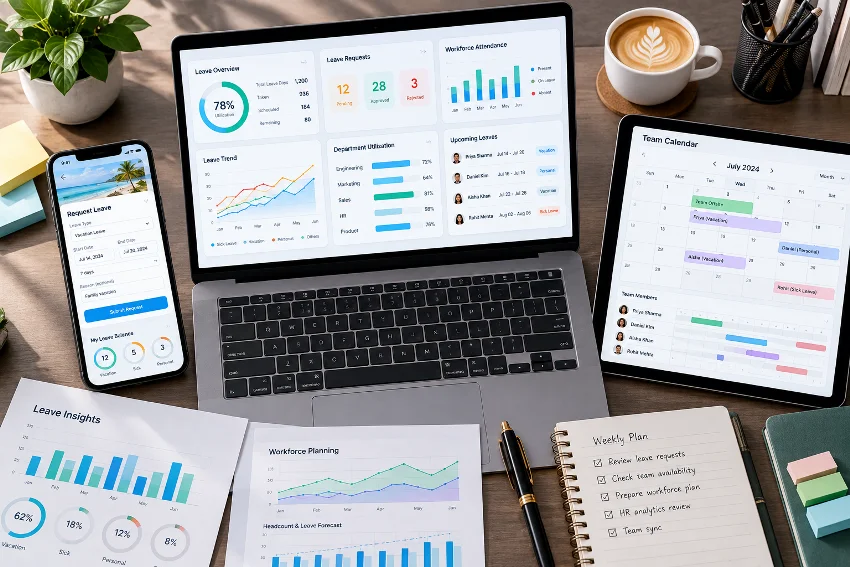
A standalone leave application may solve basic administrative problems, but enterprise value increases when it connects with other business systems.
Integration reduces duplicated data entry and helps different departments work with consistent information.
HRIS and Human Capital Management Integration
Human Resource Information Systems, commonly called HRIS platforms, maintain important employee records.
These may include employment status, organizational department, job classification, reporting relationships, and working schedules.
Connecting leave administration with an HRIS allows relevant employee information to remain synchronized.
When someone transfers departments, the leave platform can update reporting relationships and approval routing according to the organization’s rules.
When a new employee joins, their account and applicable leave policies can be provisioned automatically.
Microsoft’s identity provisioning documentation describes how automated provisioning can create, maintain, and remove access as employment information changes.
These capabilities help organizations reduce manual account administration and improve identity consistency.
Payroll and Attendance Synchronization
Payroll integration is especially important when absences affect compensation.
Unpaid leave, certain sick leave arrangements, and other absence categories may require payroll adjustments.
Without integration, HR teams often transfer information manually between systems.
A connected platform can send approved absence records to payroll according to configured processing schedules.
For example, approved unpaid leave could generate a payroll adjustment after the relevant policy conditions are validated.
The integration must distinguish between paid and unpaid absence types and handle retroactive corrections carefully.
Reconciliation reports can identify mismatches before payroll is finalized.
Calendar and Workforce Scheduling Integration
Modern businesses also need visibility into employee availability.
Connecting leave information with workforce scheduling applications can help managers plan coverage during busy periods.
An approved absence might update a team calendar or trigger a staffing review.
In a customer support department, managers could identify overlapping vacation requests before finalizing operational schedules.
However, calendar integrations should avoid exposing confidential medical information or unnecessary personal details.
Displaying a colleague as unavailable is usually more appropriate than revealing sensitive reasons for an absence.
API Architecture and Data Synchronization
Application programming interfaces, or APIs, allow enterprise systems to exchange information.
REST APIs and event-driven integrations can support synchronization between leave software, payroll platforms, HRIS databases, and scheduling tools.
Organizations should establish clear ownership of employee records and define which application is authoritative for each data field.
For example, the HRIS may own employment status, while the leave platform manages approved absence transactions.
Good integration design also includes error handling, duplicate prevention, retry mechanisms, and auditable transaction histories.
These technical details may seem invisible to everyday users, but they are essential for maintaining relable enterprise operations.
4. Advanced HR Analytics and Workforce Intelligence
One of the biggest advantages of digital leave administration is the ability to transform operational records into meaningful workforce insights.
Instead of simply counting absent employees, HR teams can analyze broader patterns that influence staffing and organizational planning.
Measuring Employee Absence Rates
Absence rate is a common workforce metric.
A basic calculation compares working time lost through a defined category of absence with the total scheduled working time.
Absence Rate (%) = (Absence Time ÷ Scheduled Working Time) × 100
Suppose a department schedules 20,000 working hours during a quarter and records 600 hours of sickness absence.
Its sickness absence rate would be 3%.
However, organizations must define what counts as absence consistently. Annual vacation, parental leave, sickness absence, and unplanned absences should not automatically be combined into one performance measure.
The correct interpretation depends on the business question being examined.
Identifying Seasonal Workforce Patterns
Historical leave records can reveal seasonal trends.
Retail organizations may experience concentrated vacation requests around major holidays, while educational institutions may follow academic calendars.
Analytics dashboards can visualize these patterns across departments and locations.
For example, a company may discover that vacation demand increases every December while customer service workloads also rise.
Managers can use this insight to plan temporary staffing or encourage earlier coordination of voluntary leave schedules.
The goal should be better resource planning rather than unfairly restricting employee entitlements.
Predictive Analytics for Staffing Forecasts
Predictive analytics uses historical information to estimate future outcomes.
In workforce planning, models might estimate expected team availability during particular periods.
A forecast could combine historical absence levels, staffing schedules, department size, and known seasonal demand.
However, predictions should remain probabilistic.
Past absence patterns do not establish that particular employees will become ill or require leave in the future.
Organizations should avoid using sensitive health information to generate intrusive individual risk scores.
The CIPD recommends connecting people analytics with genuine business problems while considering ethical and privacy implications.
Creating Actionable HR Dashboards
An effective dashboard presents information that supports decisions rather than overwhelming users with unnecessary metrics.
Common measures include:
- Average leave approval time
- Outstanding employee requests
- Leave balance distribution
- Department-level availability
- Planned versus unplanned absence
- Policy exception frequency
Different roles require different levels of detail.
HR administrators may need comprehensive operational information, while executives generally benefit from aggregated trends and organizational indicators.
Microsoft Power BI, for example, supports row-level security to restrict which records certain report viewers can access.
Analytics platforms must still be configured carefully because permissions, underlying data models, and access privileges affect confidentiality.
5. Managing Compliance, Security, and Employee Privacy
Enterprise leave software handles information that may include employment records, compensation-related data, and sensitive personal circumstances.
Strong governance is therefore as important as convenient automation.
Supporting Employment Law Compliance
Leave requirements vary significantly across countries and sometimes between regions within the same country.
Organizations may need to accommodate statutory annual leave, maternity or parental leave, medical absences, disability-related accommodations, and contractual benefits.
For example, the United States Family and Medical Leave Act provides eligible employees of covered employers with qualifying job-protected leave under specific conditions.
Other jurisdictions have different eligibility rules, payment requirements, and documentation obligations.
Software should allow local policy configuration instead of assuming a universal legal framework.
Employers also need human review processes for situations that cannot be resolved through automatic rules.
Legal compliance ultimately remains the organization’s responsibility, even when software helps administer the process.
Protecting Confidential Employee Information
Absence records can reveal sensitive personal information.
An employee requesting medical leave may provide documentation that should not be available to their entire management chain.
Role-based access controls can restrict information according to legitimate responsibilities.
For example, a line manager might see an employee’s availability status without accessing confidential medical documentation.
Encryption, audit logs, secure authentication, and appropriate data retention policies provide additional protection.
The NIST Privacy Framework offers a structured approach for identifying and managing organizational privacy risks.
Designing Fair and Transparent Leave Policies
Automated systems should apply policies consistently, but consistency alone doesn’t guarantee fairness.
Poorly designed rules can unintentionally disadvantage employees with disabilities, caregiving responsibilities, or nonstandard schedules.
Organizations should evaluate automated approval criteria before deployment.
A system that rejects requests whenever staffing falls below a fixed threshold may be inappropriate for certain protected leave categories.
Employees should also understand how decisions are made and how to request human review.
Transparent processes support trust while allowing HR professionals to handle complex situations responsibly.
Securing Enterprise Integrations
Every connection between enterprise applications introduces additional security considerations.
APIs should use strong authentication, restricted permissions, encrypted communication, and appropriate access validation.
The OWASP API Security Top 10 identifies broken authorization and authentication among significant API security risks.
These issues are particularly relevant when applications exchange confidential employee records.
Security testing should therefore cover more than the user interface.
Organizations also need to evaluate data access at API endpoints, system accounts, integrations, and exported reports.
6. Implementing a Scalable Enterprise Leave Management Strategy

Successful implementation involves more than selecting software with attractive features.
Organizations must understand current processes, prepare accurate employee data, and coordinate changes across HR, finance, IT, and operational teams.
Evaluating Organizational Requirements
The first step is identifying how leave currently works.
HR leaders should review existing policies, approval structures, employee categories, reporting requirements, and payroll dependencies.
For multinational organizations, the assessment should include local legal requirements and country-specific working calendars.
It is also important to identify recurring operational problems.
Perhaps managers frequently overlook requests, employees cannot verify balances, or payroll adjustments require excessive manual work.
These issues provide a practical basis for evaluating potential software capabilities.
Designing a Phased Implementation
Large organizations may benefit from introducing the platform gradually.
A pilot deployment could begin with one department or region before expanding across the enterprise.
During the pilot, teams can test accrual calculations, manager permissions, approval escalation, and payroll synchronization.
Parallel testing against existing records can identify discrepancies before the new platform becomes authoritative.
Historical data migration also requires special attention.
Incomplete employee histories or incorrect carryover balances can reduce confidence in the software immediately after launch.
A structured rollout creates opportunities to correct these problems before they affect the entire workforce.
Encouraging Employee Adoption
Even sophisticated technology delivers limited value when employees don’t use it correctly.
Clear training materials and intuitive interfaces help people understand how to submit requests, review balances, and track approvals.
Managers need additional guidance on scheduling visibility, approval responsibilities, and policy exceptions.
Mobile accessibility can be particularly valuable for frontline employees who do not regularly use desktop computers.
Communication should explain how the platform improves existing processes, rather than presenting the implementation as another administrative requirement.
Listening to employee feedback during rollout can reveal confusing workflows that weren’t identified during technical testing.
7. Measuring ROI and Preparing for Future HR Automation
Enterprise technology investments should deliver measurable operational improvements.
However, organizations need to evaluate both financial efficiency and the quality of the employee experience.
Calculating Automation Return on Investment
A basic return-on-investment model compares measurable benefits with total implementation and operating costs.
ROI (%) = ((Total Benefits − Total Costs) ÷ Total Costs) × 100
Suppose an organization estimates that automated leave administration saves $60,000 annually in labor and error-related costs.
If annualized software, implementation, support, and integration costs total $40,000, the illustrative ROI would be 50%.
These figures are hypothetical and should not be treated as industry benchmarks.
Real evaluations should include software licensing, configuration, data migration, employee training, maintenance, and ongoing administration.
Benefits may include reduced processing time, fewer corrections, improved staffing visibility, and more efficient reporting.
Establishing Meaningful Performance Indicators
Measuring success requires clear baseline data.
An organization might compare average request approval times before and after implementation.
It could also track payroll corrections associated with leave records or the number of manual HR interventions.
For example, reducing median approval time from three working days to one day would represent a meaningful operational improvement.
However, speed should not come at the expense of fair decisions or necessary review.
Employee satisfaction and policy accuracy deserve attention alongside processing efficiency.
A balanced assessment helps organizations avoid optimizing purely for administrative convenience.
The Future of AI-Powered Leave Administration
Artificial intelligence may introduce additional capabilities into enterprise absence management.
Potential applications include conversational employee assistance, scheduling recommendations, anomaly detection, and forecasting department-level availability.
An AI assistant could explain an organization’s leave policy or guide employees through routine request procedures.
Analytics models might also identify unusual administrative patterns that require human investigation.
However, automated recommendations should remain explainable and subject to appropriate oversight.
Sensitive leave decisions should not depend exclusively on opaque algorithms.
The most succesful implementations will likely combine advanced technology with transparent policies, strong privacy protection, and informed human judgment.
An enterprise Leave Management System transforms traditional absence administration into a more efficient, transparent, and data-driven HR process. By combining workflow automation, payroll integration, workforce analytics, and strong governance, organizations can reduce administrative complexity while supporting employees.
Start by evaluating existing leave policies, identifying operational bottlenecks, and defining measurable goals. A carefully implemented platform can strengthen workforce planning and support sustainable organizational growth.
Financial markets involve diverse perspectives, evolving conditions, and a wide range of investment approaches. This investment directory offers an additional route to discovering finance-related websites, market commentary, and educational references. Explore these sources to broaden your research and examine investment subjects from multiple angles.